
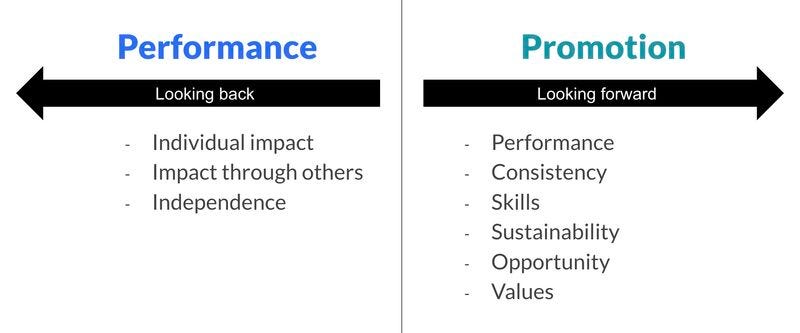
A good promotion empowers someone to take on more responsibility and feels great for the team. A bad promotion can break a team as the person fails to deliver on things people depend on them for. It gets worse long term, as the underperforming officer now sets a bad example for the org. This misguides people who don’t understand the standards and demoralises the people who do. It’s not even good for the officer, getting stressed as they struggle while everyone else is frustrated at them.
At Open Government Products I use a framework to help avoid this. Performance looks back and measures how much impact someone has made, while promotions look forward and estimates how much responsibility they will be able to take. While performance is a key factor, making a good promotion requires looking at several other things too.
The most common mistake is promoting someone immediately after a period of good performance. Everybody has good years and bad years, and there is a lot of luck that goes into whether a project goes smoothly. Promoting someone too soon sets them up for failure because either their next opportunity isn’t as good, they’re missing some key skills, or they just burnout because you promoted them while they were working unsustainably. Whatever the reason, waiting to see if their performance is consistent is the most reliable way of avoiding these problems.
A common pattern I see is junior officers trying to get promoted by working super hard but not taking the time to develop their skills. While you should recognise them with good performance ratings, promoting them is a mistake. This creates a culture of people working harder and harder until they literally run out of hours in a day, then get stuck barely meeting expectations while quickly burning out. That’s why it’s important someone has the right skills and is working sustainably before they get promoted, otherwise you’re just locking them into a death spiral.
To reduce the pressure of getting promoted early, at OGP we allocate bonuses so that people with the same performance get the same total compensation, regardless of their level. So if a junior engineer performs at a senior level, his salary + bonus for that year will be the same as a senior engineer’s. This means there is little downside to just staying lower level and outperforming, only taking on promotions when you’re really ready for it.
It’s impossible to get this exactly right. My philosophy is that it’s better to have a team of outperfomers than a team of underperformers. The former might be a bit frustrated that they’re not promoted, but overall they’re happy they’re exceeding expectations and working well with each other. On the other hand, the latter is frustrated as they let each other down, while anxiously overworking to try and meet their targets. At OGP we have around 40% of people outperforming and we’ve managed to get underperformance down to under 5%.